
The approval of the General Audiovisual Law in 2022 updated the Spanish regulatory framework, tackling some of the challenges presented by agents such as streaming platforms, but also leaving open some other related to diversity protection. The LEXCAV project, financed by the Programa Estatal de I+D+i Orientada a los Retos de la Sociedad and developed by the Estudos Audiovisuais research group, has conducted during the last three years an evaluation of the impact of this Law in the audiovisual sector, focusing specifically in its effects in the linguistic field, and this second international symposium –which has the collaboration of the Instituto de Estudos e Desenvolvemento de Galicia)– will address some of the main issues faced by the audiovisual system nowadays, with the presents of experts both from the academia and the professional field.
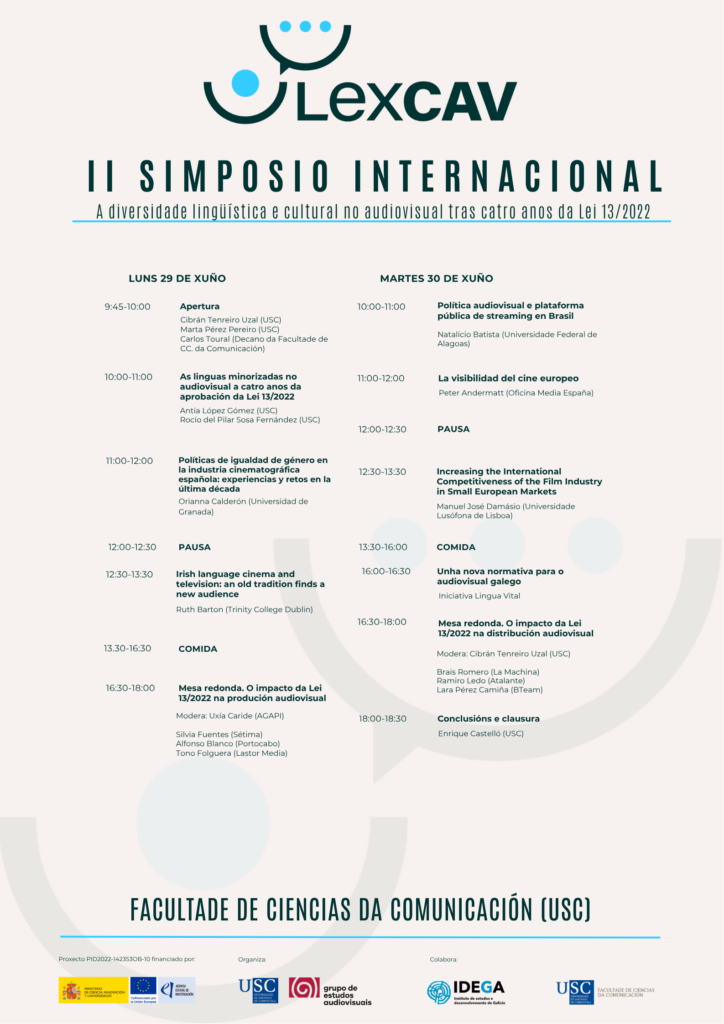
Hence, and after the opening with the recently elected Dean of the Communication Science Faculty, Carlos Toural, and the coordinators of the Symposium, Marta Pérez Pereiro and Cibrán Tenreiro, the first day (June 29) will have the USC researchers Antía López (Head of the project) and Rocío del Pilar Sosa dealing with the impact of the Law in minorized languages four years after its approval. Next, Orianna Calderón (Universidad de Granada) will focus on a different axis of diversity in the Spanish audiovisual policy: gender equality. The Trinity College Fellow Emeritus Ruth Barton will dig into the relation between audiovisual policy and minorized languages in a different frame, as is the Irish. The afternoon will be centered in the intervention of professionals, with producers Silvia Fuentes (Sétima), Alfonso Blanco (Portocabo) and Tono Folguera (Lastor Media) –with works such as As liñas descontinuas, Cuñados or Creatura– engaging in a round table about the impact of the abovementioned Law in their activity.
The second day will start with the intervention of Natalício Batista, researcher of the Brazilian Universidade Federal de Alagoas and member of the team of the public streaming platform Tela Brasil, who will tackle this experience within the audiovisual policy in the biggest lusophone country. Peter Andermatt will follow: the director of Oficina Media España will address the visibility of European cinema from his perspective as part of one of the fundamental organizations for funding and promoting cinema in the EU. In a related vain, the issue of internacional competitiveness of small cinema industries will be the object of Manuel José Damásio’s intervention; the conference of the Director of the Department of Cinema and Media Arts at Universidade Lusófona de Lisboa will close the morning of June 30. In the afternoon, the Lingua Vital initiative will present the proposal “A new regulation for Galician audiovisual”. The Symposium will then present a new round table, this time focused on audiovisual distribution and with the presence of Brais Romero (La Machina), Ramiro Ledo (Atalante) and Lara Pérez Camiña (BTeam), whose companies have been in charge of examples of audiovisual diversity such as 360 curvas, Orlando, mi biografía política or Sirât. Finally, the other Head of the project, Enrique Castelló, will close the event with some conclusions.