
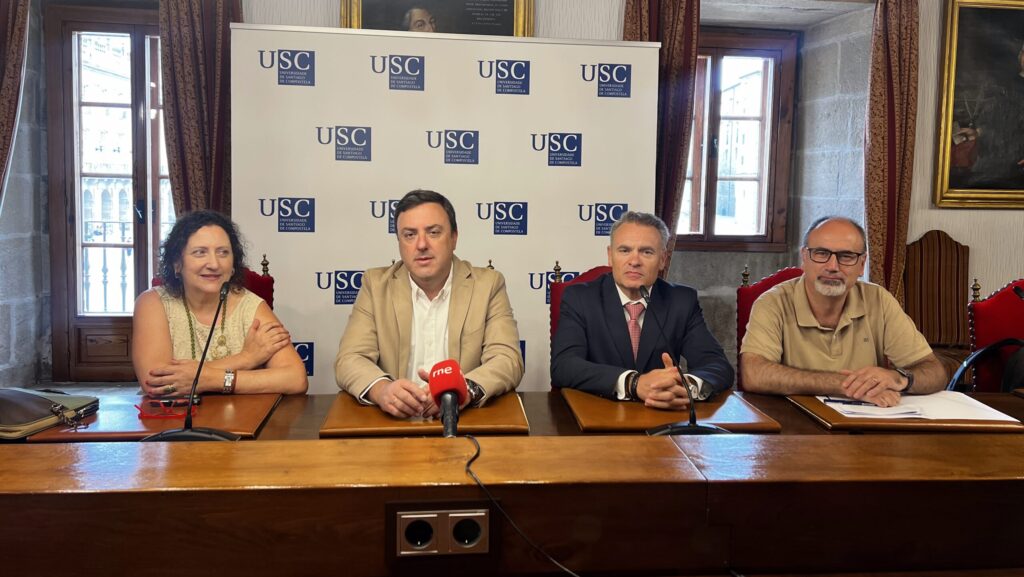
The Institute for Studies and Development of Galicia (IDEGA) at the University of Santiago de Compostela (USC) presented its 40th report, “The Galician Economy”, a study it has conducted continuously since 1986. Its directors, Dolores Riveiro and Melchor Fernández, explained that the document can be summarized as showing “favorable growth in most sectors of activity, confirming a remarkable capacity for adaptation in a complex international context.”
The presentation took place in the Rector’s Hall at the USC and also included the participation of the president of the A Coruña Provincial Council, Valentín González Formoso, and the general manager of Caixa Rural Galega, Jesús Méndez Álvarez-Cedrón.
The 2025 data are “clearly positive,” explained the study’s directors. Galicia closed the year with the largest increase in employment in the last decade, with women leading the way and immigration consolidating its position as one of the main drivers of job creation. The coordinators explained that the report, “The Galician Economy,” should contribute to providing a “rigorous analysis supported by empirical evidence” to better understand current challenges and guide a more informed debate. In this regard, they pointed out that the Galician economy will have to address the aging population, the need to increase productivity and added value, adapt to the technological and environmental transition, and ensure generational renewal to meet the needs of the labor market.
In this edition, 15 professors from the University of Santiago de Compostela (USC) analyzed the macroeconomic evolution of the region in 10 chapters. During the presentation, the experts highlighted two controversial aspects of the labor market. Firstly, they warned of the difficulty in drawing conclusions regarding the estimated number of job vacancies in Galicia, since official sources use different methodologies and coverage. “There is insufficient data to speak of a widespread labor market crisis, as the problem seems to be concentrated in certain sectors and regions. Furthermore, it is necessary to improve the statistics,” they explained.
On the other hand, the study concludes that Galicia has a higher absenteeism rate than the national average, but the report highlights the problem of identifying the total number of absences from work, including those due to temporary disability. Experts believe that the greatest impact may lie in presenteeism—people who go to work while sick—a phenomenon that is “less visible and difficult to measure.”
Download the report here.