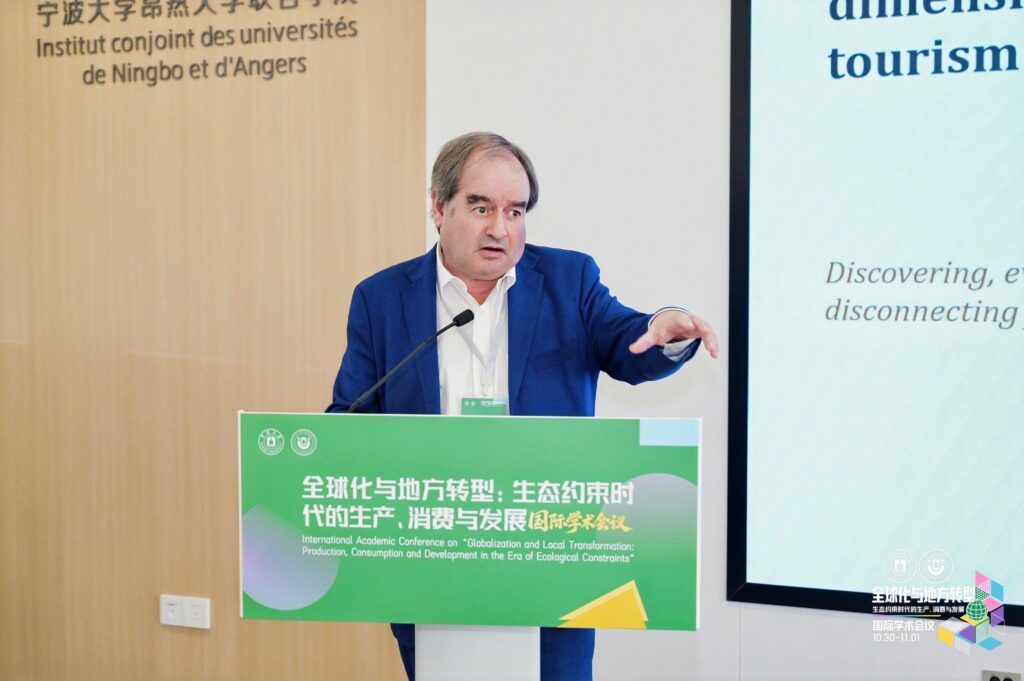

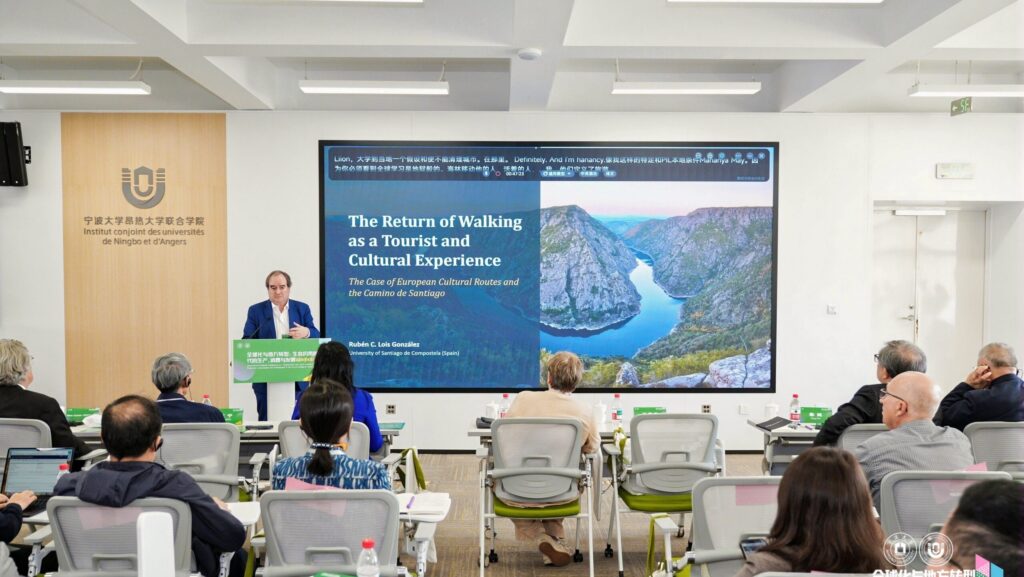
Ningbo University (NBU) in China, founded in 1986, celebrated its 40th anniversary in October. As part of this commemoration, the institution is hosting various international symposia and dialogues, including the international conference “Globalization and Local Transformation: Production, Consumption, and Development in the Era of Ecological Constraints.” Professor of Geography Rubén C. Lois traveled there to deliver a presentation on European cultural routes.
This international academic forum brings together global researchers and experts in economic geography, regional development, and sustainability to analyze the impact of green transitions at a territorial level. The event was attended by around one hundred participants who presented work on sustainable tourism. Rubén Lois explains that, in China, rural tourism is gaining ground at the expense of traditional “mass tourism.” In his presentation, he focused on the Camino de Santiago—the first European cultural route with a historical origin. This sparked the interest of researchers in Ningbo, who see the Camino model as an example to follow for developing tourism products based on historical cultural routes in their own city, which has a population of 7.5 million. Consequently, IDEGA will provide advisory support to Ningbo University as it researches and develops this new model.