
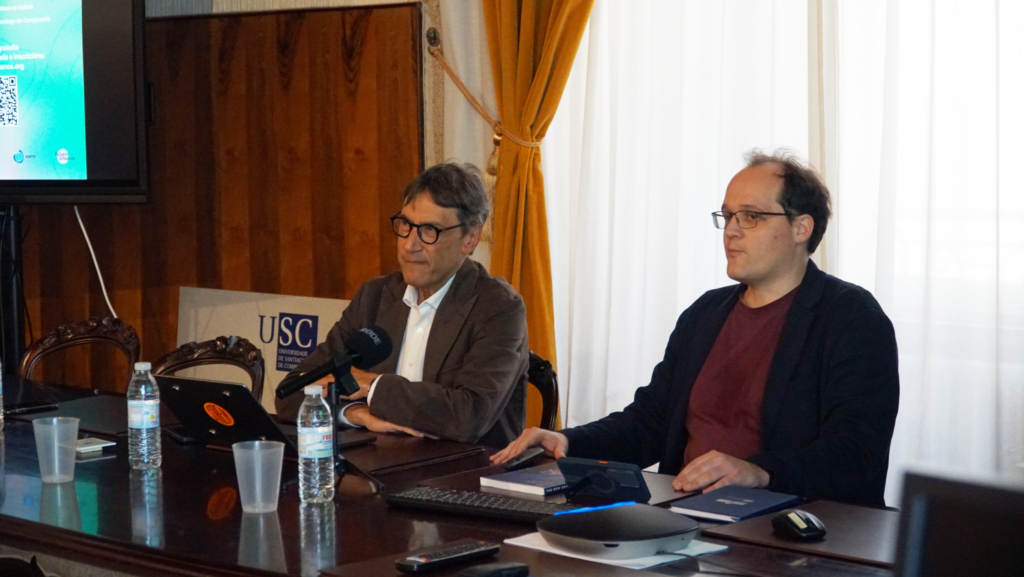
Different ways of imagining the city shape the future. This was one of the main conclusions of the conference ‘New Urban Visions: The Imprint of Utopias on the Contemporary City,’ organized by the USC project Arsogal and the Urban Futures Seminar of the Territorial Analysis Group (ANTE). Leading international experts in landscape, territory, and housing regulation visited the Faculty of Geography and History to contribute new perspectives on ideal living spaces. “How to improve livability in cities is a very hot topic in our society,” explains José Ignacio Vila, professor at USC and researcher at the Institute of Studies and Development of Galicia (IDEGA).
In a context marked by profound uncertainties linked to economic and environmental crises, the ANTE group, in collaboration with Arsogal, a project that studies Galician architecture from the perspective of designed buildings, proposed reflecting on the transformation of spaces to respond sustainably and inclusively to various contemporary challenges. To that end, experts such as Monica Degen from Brunel University London; Dario Negueruela from the University of Zurich; Gizem Deniz Güneri from the Middle East Technical University in Ankara; and Francesca Artioli from the Paris School of Urban Planning, who opened a debate around the platform economy and how to regulate the proliferation of short-term rentals in European cities, came together.
“The city of the future is a city in transformation. We must take into account new technologies, but also create more welcoming cities based on emotion and sensitivity,” explains Villa. Typically, the utopias that reach the public are dominated by archetypes conveyed in films, with a “Director-driven” version focused on skyscrapers and cars that drive themselves. However, the proposal from the University of Santiago de Compostela (USC) starts from the premise of “building ideal cities according to our aspirations.” “The projects presented by the international researchers weren’t implemented, but they envisioned other possible cities, which influenced the work that was ultimately done,” explains the USC professor and organizer of the conference.
Now, with the development of artificial intelligence, urban visions are being affected. “We can’t define the Galicia of the future; it will depend on the locations where it’s projected: on Vigo’s waterfront, in the port of A Coruña, or in the City of Culture and its integration into Santiago de Compostela. We must consider what kind of urban model we want and do it together with the citizens, through a broad participatory process that addresses urban agendas; we need to co-create. But this requires resources, time, and will. The way forward is to design projects that solve current problems,” explains José Ignacio Vila.