

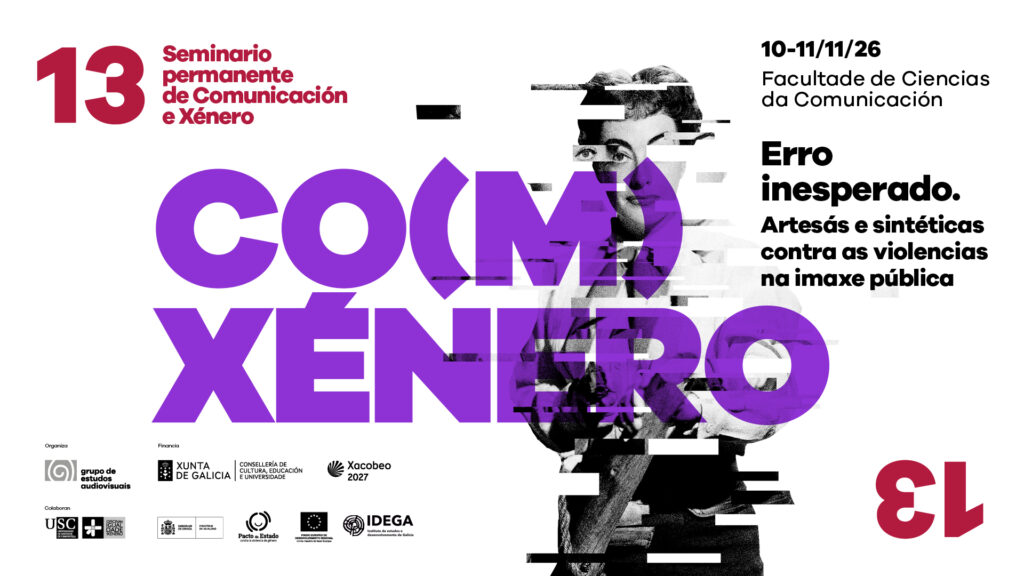
On November 10 and 11, the Faculty of Communication will host the thirteenth edition of the CO(M)género seminar, titled this year ‘Unexpected Error: Artisanal and Synthetic Approaches Against Violence in the Public Image.’ Registration is now open; participation is free (subject to capacity), and attendance is a recognized activity for various EDIUS doctoral programs, particularly the program in Contemporary Communication and Information.
In the summer of 2026, engineer Jacob Coxon resigned from his position at Anthropic—a leading company developing generative audiovisual AI—expressing the fear that AI could destroy humanity before the decade ends. Without going so far as to envision a cinematic apocalypse, recent research has consistently shown that AI incorporates racial and gender biases that perpetuate inequalities and exclusion. The lack of a gender perspective in the development of this image-creation technology necessitates a collective reflection on technology that incorporates two complementary lines of feminist thought: on one hand, following Donna Haraway’s Cyborg Manifesto, appropriating technological tools to challenge patriarchal mandates; on the other, embracing the artisanal—the small-scale, autonomous, and manual—to defy capitalist, technophilic acceleration. Both strategies are necessary to confront the violence against women that occurs within the public image—violence that leads to revictimization—and to propose alternatives rooted in diverse feminist practices. In this thirteenth edition of CO(M)GÉNERO, we present a gathering of female creators and researchers who analyze the traces of the patriarchy in representations of women’s bodies and develop images—occupying both virtual and physical public spaces—to stand against violence.
On November 10, designer and educator Uqui Permuy will discuss her “Compostela en negro” campaign—the most iconic image of the fight against gender-based violence in Galicia—while researchers Bea Gutiérrez and Paulina Cañería will analyze the unsettling presence of synthetically created influencers on social media as a form of violence against women. The November 11 session will feature artist and researcher Teresa Ferreiro, focusing on representations of gender-based violence in comics and graphic novels. This edition will conclude with the unique work of visual artist, programmer, and educator Marta Verde, who will use imagery and computer technology to explore visual representations of violence against women.