Academic cooperation between Spain and Portugal and an analysis of the Iberian Peninsula’s major territorial challenges are the focus of the 19th Iberian Geography Colloquium, held on October 14, 15, and 16 at the Lugo Campus. The event brings together specialists from both regions under the theme “Iberian geography as an example of the contributions of transnational academic cooperation,” addressing key issues such as climate change, the housing crisis, demographic challenges, and tourism.
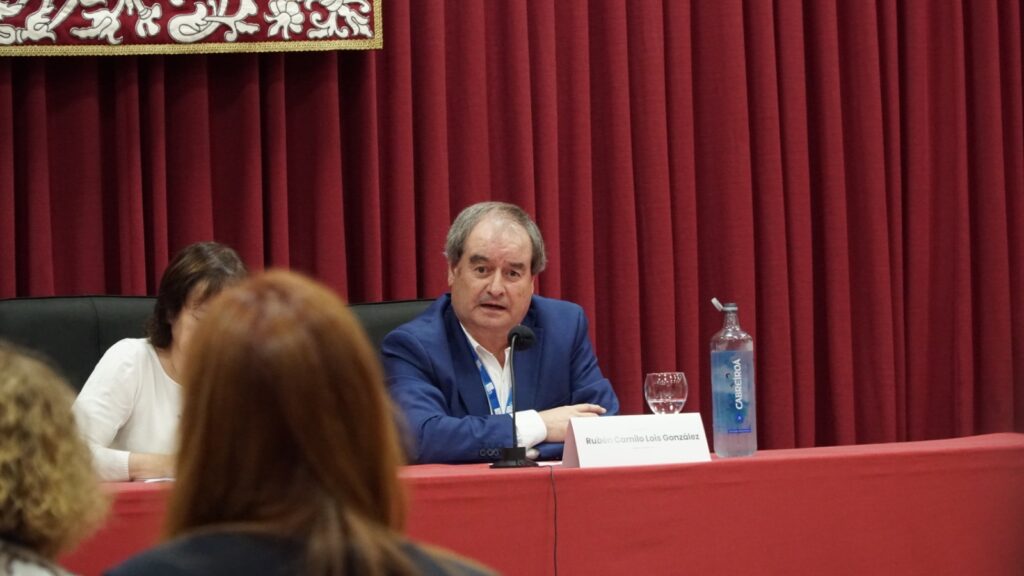
This edition is organized by the Institute for Galician Studies and Development (IDEGA), in collaboration with the Spanish Association of Geography (AGE) and the Portuguese Association of Geographers. During the opening ceremony, held this Wednesday at the Higher Polytechnic School of Engineering, IDEGA Director Rubén C. Lois highlighted the significance of hosting the colloquium in Galicia, a territory that maintains historical, cultural, and academic ties with Portugal. Lois recalled the long history of relations between the Galician and Portuguese geography communities—even during the dictatorship—and noted the importance of holding the colloquium at the Lugo Campus: “It is a colloquium that truly resonates with us.”
For her part, AGE President Asunción Blanco Romero emphasized that the gathering fosters closer ties between researchers working in geographically close territories who do not always maintain regular academic contact. Carlos Amiama Ares, Director of the Higher Polytechnic School of Engineering, highlighted that solving current problems requires collaboration across different fields of knowledge, as well as the openness of university institutions to research initiatives that propose solutions to the challenges facing our societies. Carlos Núñez Temes, Vice-Rector for Academic Organization and Educational Offerings, stated that “cooperation” is the defining theme of the 19th Iberian Colloquium. In his remarks, he emphasized that future challenges require collaboration among diverse viewpoints and perspectives. Núñez Temes also congratulated IDEGA on hosting this gathering during a particularly significant year for the institute, which is marking its 50th anniversary as a leading center for the interdisciplinary study of Galicia. Furthermore, he highlighted the value of bringing together knowledge and researchers from various fields to advance the understanding of territorial and social transformations. “Your work today will be the success of the future,” he declared.