
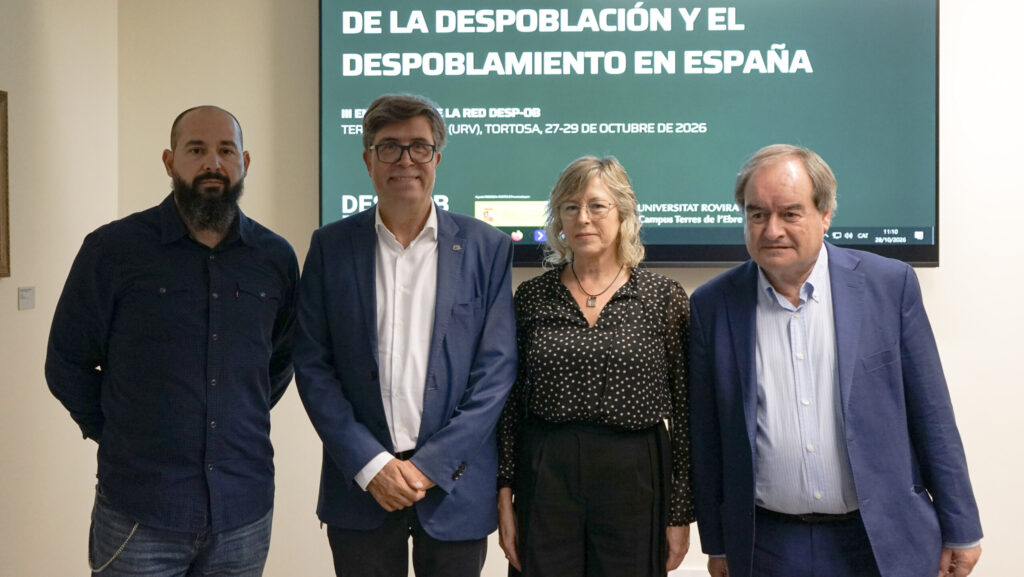
The Strategic Network for the creation of an Observatory on Depopulation (DESP-OB)—comprising eleven Spanish research centers—has gathered in Tortosa for its third meeting, held at the Terres de l’Ebre Campus of the Universitat Rovira i Virgili (URV). The objective: to gain firsthand insight into the region and analyze effective practices to combat depopulation in what is known as “emptied Spain” (España vaciada).
The institutional welcome, held this Wednesday in the Aula Magna (Great Hall), featured the participation of Xavier Farré, Director of the Terres de l’Ebre Campus; Miquel Alonso, Director of Territorial Services for Territory, Housing, and Transition; Mar Lleixá, Mayor of Tortosa; and Rubén C. Lois, coordinator of the DESP-OB Network and Director of the University Institute for Galician Studies and Development (IDEGA).
Farré explained that the universities and research centers involved in the project are meeting on campus on October 28th and 29th, positioning the Terres de l’Ebre region as “a key reference point” regarding the issue of depopulation. Describing the initiative—now 15 months underway—as “a project for the future,” the director emphasized the importance of carefully examining strategies to address the demographic challenge, with the goal of “achieving results that benefit Spanish society as a whole.”
For her part, the mayor highlighted the multidisciplinary nature of the DESP-OB network and the role of academia in generating knowledge to inform public policy. She added that, in places like Tortosa, measures designed to “retain” talent are vital, pointing to remote work as a significant “opportunity” for individuals who might otherwise be unable to live in such towns and cities. The DESP-OB initiative originated at IDEGA, an institute within the University of Santiago de Compostela (USC) that secured funding from the Ministry of Science, Innovation and Universities to launch this strategic network—an initiative aimed at analyzing, raising awareness of, and addressing depopulation processes in Spain from an interdisciplinary perspective. In addition to IDEGA and the URV, the DESP-OB network includes units affiliated with the universities of Oviedo (RegioLab), León (GIEA), Zaragoza (CEDDAR), the Balearic Islands (GREI), Valencia (UDERVAL-IIDL), Alicante (IEI), Murcia (CEMUGE), and Málaga (INACOM), as well as the Research Group on Aging (GIE) from the Spanish National Research Council (CSIC).
The network brings together specialists in fields such as geography, economics, and communication sciences, creating a research space dedicated to understanding and tackling the demographic challenge from multiple perspectives. The first meeting took place in Lugo, followed by a second meeting in Mieres. The coordinator, Rubén C. Lois, explained that these gatherings provide an opportunity to explore different territories and track best practices. “Coordination allows us to observe numerous examples of similar challenges—such as phenomena of demographic regression, the decline of certain rural areas, or the abandonment of villages,” he stated.
In Tortosa, the various teams will work on developing a set of indicators for rural areas. “We need to create complex indices and maintain coordination with public authorities. Furthermore, these meetings facilitate a qualitative approach: it is essential to visit the areas in person and speak with the local people.” The members will tour the city and the Terra Alta region, where they will be welcomed by the Consell Comarcal (County Council). Additionally, they will visit Corbera d’Ebre alongside the Consorci Memorial dels Espais de la Batalla de l’Ebre (COMEBE), and the Celler Cooperatiu de Gandesa (Gandesa Cooperative Winery), accompanied by the cooperative’s president.