
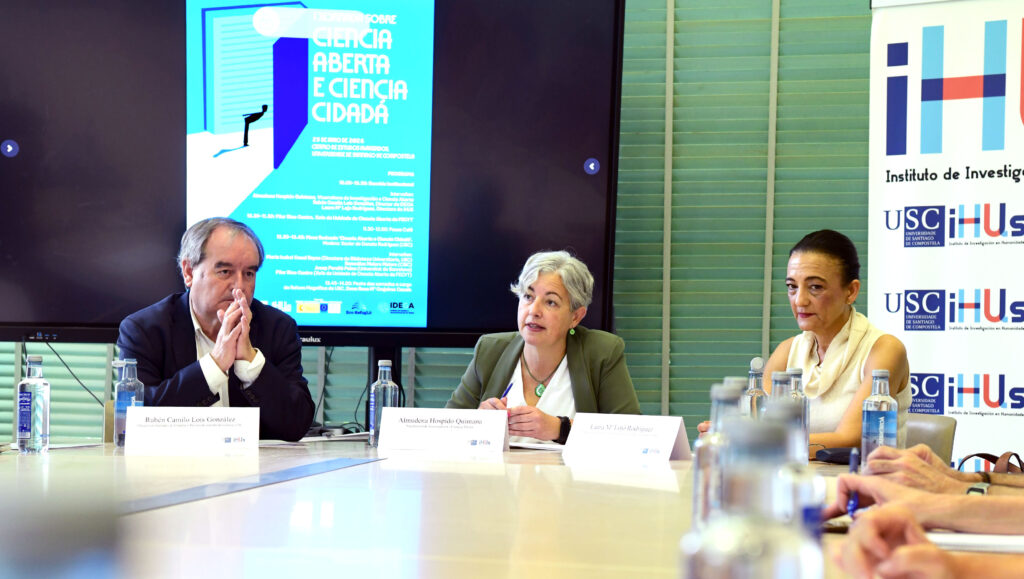
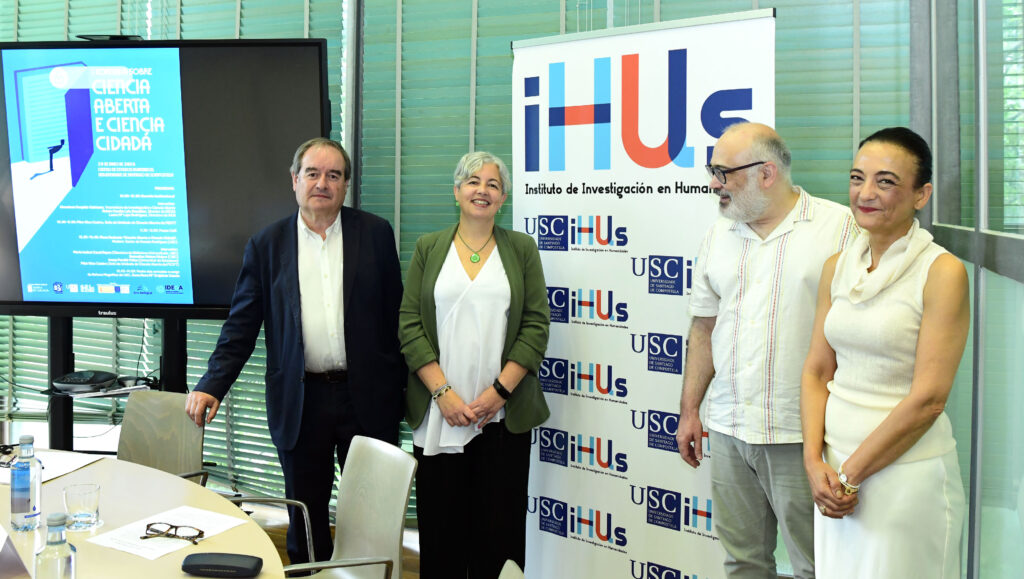
The importance of moving towards more transparent, collaborative, and accessible research models was the focus of the 1st Open Science and Citizen Science Conference, a meeting that brought together leading experts from the university and research community at the Center for Advanced Studies. The session aimed to reflect on the challenges and opportunities of actively incorporating citizens into research processes to promote the circulation of knowledge beyond traditional academic spaces.
The conference was opened by the Vice-Rector for Research and Open Science, Almudena Hospido; the Director of the iHUS (University Hospital of Santiago de Compostela), Laura Lojo; and the Director of Idega (Institute for Genetic Engineering and Geography), Rubén Lois. Hospido pointed out that Open Science and Citizen Science are “a new model for producing, validating, and transferring knowledge,” and a “challenge that must be addressed collectively.” For her part, Lois argued that “equality is the DNA of the Social Sciences, and there must be governance models that share science with the public; it cannot remain confined to universities.”
The event, conceived as a joint activity of the iHUS and IDEGA research centers, was organized by the Dean of the Faculty of Philosophy, Xavier de Donato (a member of the iHUS scientific council), and the Global Borders research project. The participating community developed a state-of-the-art overview of open science and citizen science, identifying best practices, remaining challenges, and opportunities for improvement. “It’s about considering how the University of Santiago de Compostela (USC) can strengthen its procedures, policies, and strategies in this area in a cross-cutting, equitable, and unbiased way, integrating these principles into research, teaching, knowledge transfer, and its relationship with society,” explained the organizer.
Open science is the umbrella term encompassing various research approaches that promote free access to scientific knowledge: publications, data, methodologies, codes, teaching materials, and evaluation processes. It includes citizen science, which involves the public from data collection and analysis to problem definition, results interpretation, and the social application of knowledge. The meeting made it clear that these processes are enriched by diverse knowledge and localized experiences.
“Citizens write a shared history, which represents the democratization of knowledge. By guaranteeing free access to science, we multiply collective intelligence,” stated Laura Lojo, director of iHUS. Participants also highlighted that the newly inaugurated university administration has, for the first time at USC, established a Vice-Rectorate for Research and Open Science, which offers “a particularly relevant institutional opportunity to promote this transformation in a coordinated and strategic manner.”