
The Institute for Galician Studies and Development (IDEGA) presented the Jean Monnet Chair “EU ASTER: Active Subsidiarity for Territorial Equity and Regions” this Monday. This initiative is designed to consolidate the University of Santiago de Compostela (USC) as a benchmark for European Union territorial governance and regional administrative capacity. Funded by the European Union under the Erasmus+ program’s Jean Monnet Actions, the Chair has already begun its activities and will operate for three years. It is led by Cristina Ares Castro-Conde, a tenured professor of Political Science and Public Administration, and will carry out its work through the EUROPEA research group and IDEGA.
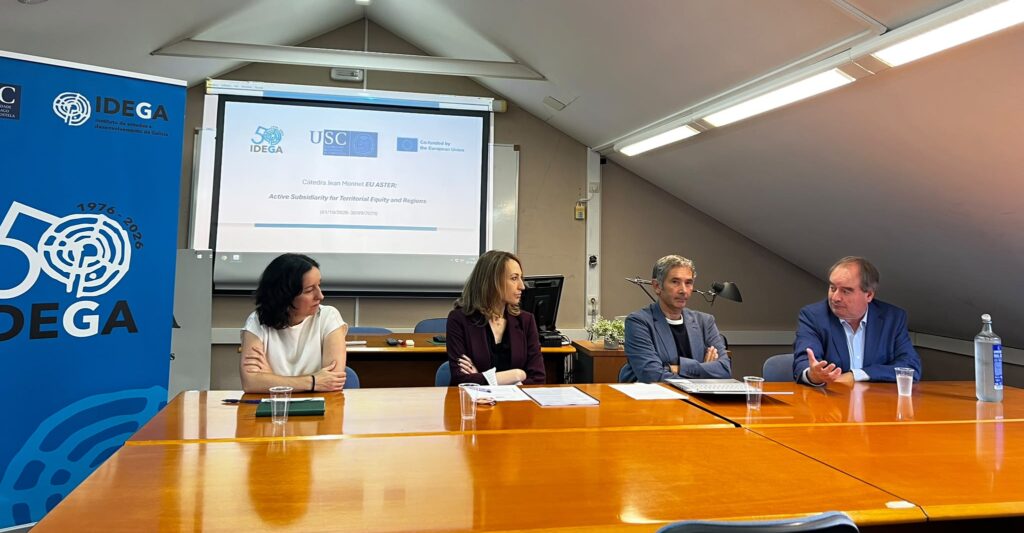
The official presentation took place in the IDEGA assembly hall. The Chair’s director was joined by Marcelino Maneiro, Vice-Rector for Innovation and Knowledge Transfer; Rubén Lois, Director of IDEGA; and Alba Alonso Vázquez, Vice-Dean for Internationalization at the Faculty of Political and Social Sciences and a member of the project team. The Vice-Rector highlighted Galicia as a territory that, “long before the European Union, was already a network of human exchange thanks to the Camino de Santiago, which created a pathway for encounters among European peoples.” “Today, we must be capable of designing new paths for collaboration that strengthen territorial cohesion and improve the governance of our institutions,” he added. “Europe needs to build bridges between institutions and territories, and listen more to regions and local areas. The insights and proposals emerging from this Chair will be invaluable in reinforcing the USC’s contribution to European debates on multi-level governance and territorial cohesion,” he maintained.
Cristina Ares noted that approximately 1,100 students will benefit from this program. “The goal is to establish a lasting study pathway on the European Union at the USC; strengthen available evidence regarding the capacity of regional administrations; improve understanding of the territorial implementation of European policies and the management of EU funds; open stable channels of dialogue among researchers, students, public authorities, and civil society; and bring European values and policies closer to the public.” EU ASTER will incorporate a 2-ECTS-credit micro-credential on ‘EU Governance and Public Administration from a Regional Perspective.’ The Chair will develop and make available an open dataset on regional administrative capacity in Spain, created in collaboration with officials responsible for EU funds across all autonomous communities. This resource will inform online analyses, research articles, and an international workshop, bringing territorialized evidence to debates on cohesion policy, better regulation, and the European Administrative Space.
Finally, the Chair will foster knowledge transfer and exchange through hybrid events featuring international experts and regional stakeholders, podcasts on the territorial dimension of EU policies, workshops on territorial equity in collaboration with IDEGA and public authorities, and EU4Youth visits to secondary schools. By the end of the initial period, EU ASTER aims to leave the USC with a stable EU studies pathway, a robust dataset on regional administrative capacity, and a lasting portfolio of materials and networks that position the university as a key hub based in Galicia—thereby helping to ensure that the voice of the regions carries greater weight in European debates and decisions regarding cohesion, administrative reform, and active subsidiarity.