
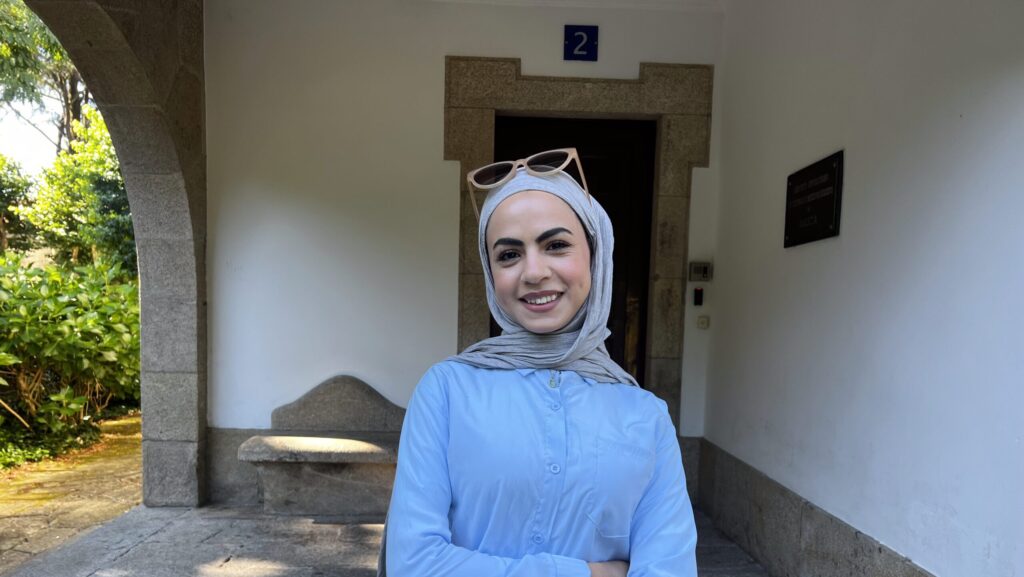
Amal Emad Ahmad AbuZnait (1995) is a Palestinian geographer from An-Najah National University (West Bank) who graduated with distinction and obtained first place in her department. The geographer’s master’s thesis at Birzeit University focused on urban master plans under occupation in Salfit. She has been pursuing a PhD in Regional Development and Economic Integration since October and has been at IDEGA for a research stay since February.
What do you address in your research?
My PhD research is titled “A Spatial Model for Agricultural Economic Integration in the West Bank: Accessibility under Geopolitical Fragmentation.” I decided to come to IDEGA because it offers a supportive research environment for my work. It provides excellent research facilities, gives me the opportunity to connect with researchers in my field, build academic collaborations, and work closely with my supervisor.
How would you define your research experience in Galicia?
My experience at IDEGA has been very positive. From the beginning, I felt welcomed and supported. Working in such an international research environment has given me the opportunity to meet researchers from different countries and similar academic fields, exchange ideas, and build new collaborations. One of the most rewarding experiences has been starting a joint research project with a colleague on the Galicia region. It is the first time I have conducted research beyond Palestine, which has been an important step in my personal, academic, and international development. I have also enjoyed participating in research seminars, and I had the opportunity to present my PhD research to my colleagues, which was a very valuable experience.
What progress would you like to achieve in the coming months?
I have been at IDEGA since mid February, and I will be staying for a few more months. I also hope to continue collaborating with IDEGA after my research stay and whenever I return to Santiago. My goal during this research stay is to continue making progress on my PhD research, attend more research seminars, and share my own research by giving another seminar about my study area. I also hope to further strengthen the academic collaborations I have started at IDEGA and continue learning from this international research environment. At the same time, I would like to improve my Spanish by practicing it with my colleagues in my daily interactions. I believe this experience is not only about learning, but also about sharing knowledge and contributing to the academic community.
What progress would you like to achieve in the coming months?
My goal during this research stay is to continue making progress on my PhD research, attend more research seminars, and share my own research by giving another seminar about my study area. I also hope to further strengthen the academic collaborations I have started at IDEGA and continue learning from this international research environment. At the same time, I would like to improve my Spanish by practicing it with my colleagues in my daily interactions. I believe this experience is not only about learning, but also about sharing knowledge and contributing to the academic community.
What opportunities did you find researching Palestine from IDEGA?
I believe every research environment has its own strengths, and my experience at IDEGA is a natural continuation of what I learned in Palestine. What makes this experience unique is the opportunity to continue researching my own region while working in a different country. It has allowed me to exchange knowledge, explore new research approaches and methodologies, and broaden my academic perspective. At the same time, it has given me the opportunity to introduce others to Palestine, its challenges, and the determination of its researchers and people.
Palestinian researchers face mobility limitations when collecting data. What was it like in your case?
Yes, that is true. Mobility is one of the main challenges when conducting research in Palestine, and it is actually one of the issues at the core of my PhD research. These challenges affect fieldwork and access to different locations. Because of that, I often rely on alternative ways of collecting data, such as using GIS and spatial data, communicating electronically with institutions like the Land Authority, following official local sources, and requesting information by email. These approaches allow me to continue my research despite the challenges.